This website no longer supports Internet Explorer 11. Please use a more up-to-date browser such as Firefox, Chrome for better viewing and usability.

This website was archived on August 28, 2025 and will no longer be updated.
This page was automatically translated by DeepL

Feltforsøg og platforme for fænotypebestemmelse

Genetisk analyse (QTL-kortlægning) og økofysiologisk analyse blev udført på grundlag af store databaser indsamlet fra felt- og platformsforsøg. Feltforsøg havde til formål at bestemme SolACE-panelernes udbytterespons på variationer i ressourcetilgængelighed. Fænotypingplatforme og forsøg under kontrollerede forhold havde til formål at indsamle data om rodarkitektur og mikrobiomrespons på kombinerede ressourceimitationer.

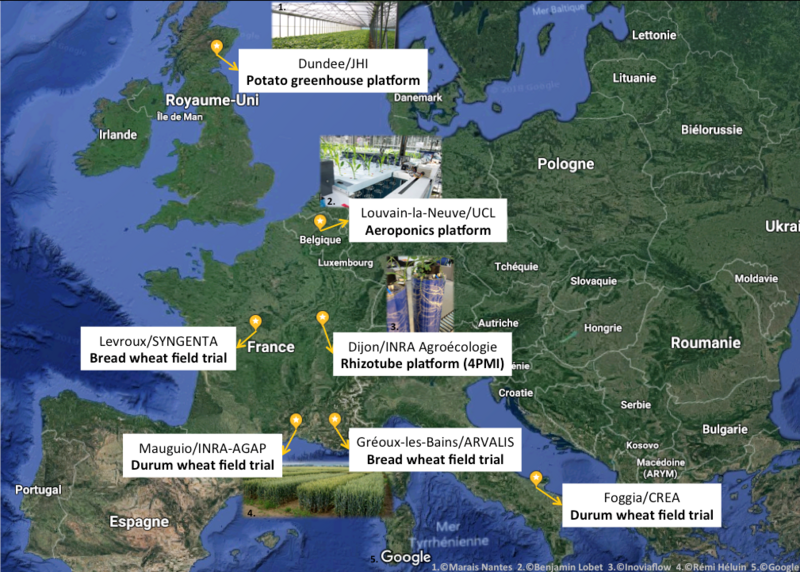
En bred vifte af hvede-genotyper blev testet i fire feltforsøg under kontrol- og kombinerede stressbetingelser. 250 brødhvede-genotyper blev testet i feltforsøg i Levroux, Frankrig og Gréoux-les-Bains, Frankrig. Yderligere 250 genotyper af hård hvede blev testet i feltforsøg i Foggia, Italien og Mauguio, Frankrig. Desuden blev de store diversitetspaneler fænotypet på rodniveau i forsøg på fænotypingsplatformen i Louvain, Belgien og Dijon, Frankrig.

I et andet trin blev 80 udvalgte genotyper (40 brødhvede og 40 durumhvede) udvalgt til nærmere analyse i semikontrollerede feltforsøg i Gréoux-les-Bains og Clermont, Frankrig og København, Danmark, samt i en fænotypingsplatform i Montpellier, Frankrig.

Ud over forsøgene med brød- og hård hvede blev 24 kartoffelsorter også afprøvet i et kartoffeldrivhus i Dundee, Skotland.

Genetiske oplysninger fra disse storstilede og målrettede forsøg blev kombineret i en modelramme, der kombinerer funktionelle strukturelle plantemodeller (FSPM) og afgrødemodeller med henblik på at forbedre vores forståelse af afgrødens ydeevne under begrænsninger.

Nyheder om fænotypeforsøg

Understanding crop and microbiome responses to combined water and nutrient limitations

Part of the SolACE project analyses crop and microbiome responses to combined water and nutrient limitations. Genetic information from large-scale field and platform trials and physiological information from targeted trials are combined in a modelling framework, which couples Functional Structural Plant Models (FSPM) and crop models in order to improve our understanding of crop performance under limitations.

Map of ongoing SolACE field and platform experiments.

Diversity panels (approximately 250 genotypes) of bread and durum wheat and a collection of 24 potato varieties have been defined and assembled. The selection was made by the French National Institute of Agronomic Research (INRA), the National Research Council (CREA) in Italy, ARVALIS, the UK-Based James Hutton Institute and SOLYNTA and was based on a priori genetic and phenotypic information.

Two field trials were installed for each of the wheat panels during autumn 2017. Bread wheat trials were sown in Levroux (SYNGENTA, France) and Gréoux-les-Bains (ARVALIS, France), and durum wheat trials were sown in Foggia (CREA, Italy) and Mauguio (INRA, France). At all places, each genotype will be exposed to combined water and nitrogen limitations and compared to a control scenario. Field partners are currently working with modellers to establish the final list of variables that will be measured.

The 24 potato varieties have gone through a first greenhouse assay to confirm the interest of the collection. The next trials are in preparation. They will focus on root system architecture, yield and canopy development, and will come up with a novel diagnostic transcriptome test.

We will soon begin the high-throughput root phenotypic platform trials that will be performed at Université catholique de Louvain (Belgium) and at INRA-Dijon (France).
By the end of the summer, the field and platform data from wheat experiments will be analysed together and discussed broadly with partners to determine a short collection of 40 genotypes that will be analysed in more detail within intensified field and platform trials.

More information about work package 2.

Do you want to add the website to the Home screen?
tap and then scroll down to the Add to Home Screen command.