 This website was archived on August 28, 2025 and will no longer be updated.
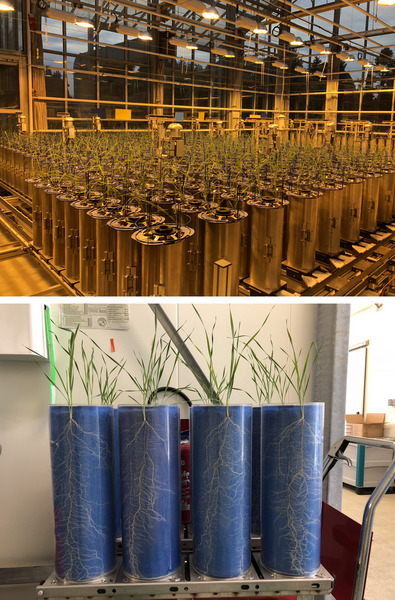
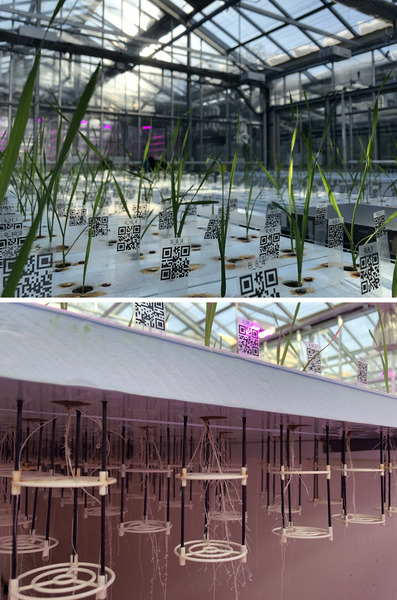
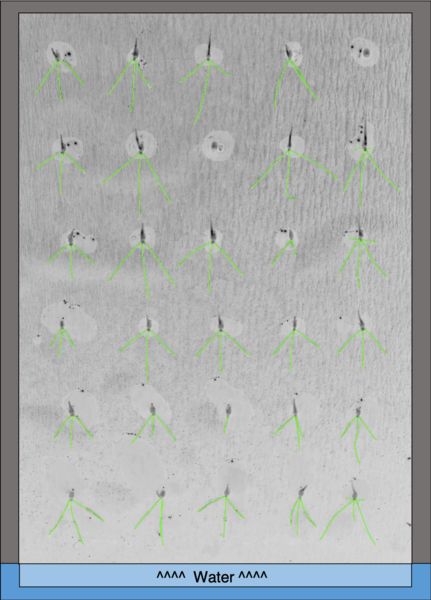
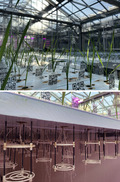
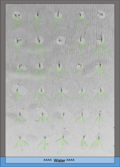
Previously, the yield response to water and nitrogen deficit of the SolACE durum and bread wheat diversity panels was determined in the field. More recently, SolACE has started using phenotyping platforms to address whether root architecture may contribute to the diversity of responses observed in the field.
Three types of experiments were carried out on the complete bread and durum wheat panels (more than 500 genotypes in total).
The first experiment monitors the development of root system architecture in a 2D rhizotube system (4PMI, INRA-Dijon, France) (see first 3 pictures). Roots grow along the inner face of a cylindric plexiglas tube, between the tube wall and a thin blue fabric which separates the root from the substrate. Conditions are controlled, including the quantity of nutrient solution delivered per plant. Every day, each rhizotube is weighed and a picture of the root system is captured. The 4PMI platform allows precise and complete monitoring of the growth and development of the root systems.
The second monitors the development of root system architecture in a 3D aeroponics system (RootPhAir, UCLouvain, Belgium) (see pictures 4 to 8). Plant roots do not encounter any physical resistance under these conditions. A nutrient solution is sprayed to maintain a film of nutrient solution at the root surface. Each root system is photographed every two hours, which provides high temporal and spatial resolution time-lapse sequences.
Finally, the third experiment evaluates the seminal root angle following germination (UCLouvain, Belgium) (see picture 9). It relies on a pouch system, where seeds are allowed to germinate on a vertical filter paper and are imaged after three days. This system facilitates the measurement of seminal root angle, which is thought to be a predictor of topsoil exploration during crop establishment.
These three systems are non-invasive and affordable. It is indeed not easy to access the root systems of plants in the field with such detail and resolution. These experiments have yielded millions of images that are currently being analysed and will generate values of root traits, in particular dynamic traits (e.g. root growth rate, emergence, maximum length, apical diameter). The pouch experiment has already confirmed a very high heritability for the root angle in the durum and bread wheat panels. Furthermore, preliminary results suggest a significant sensitivity of the seminal root angle to the water potential in the pouch and, presumably, to the topsoil water potential during germination in field conditions.
 tippen und dann zum Befehl zum Home-Bildschirm hinzufügen nach unten scrollen.