Este sitio web ya no es compatible con Internet Explorer 11. Para una mejor visualización y usabilidad, utiliza un navegador más actualizado como Firefox, Chrome

This website was archived on August 28, 2025 and will no longer be updated.
This page was automatically translated by DeepL

Ensayos de campo y plataformas de fenotipado

El análisis genético (mapeo de QTL) y el análisis ecofisiológico se realizaron a partir de grandes bases de datos recogidas en ensayos de campo y de plataforma. Los experimentos de campo tenían como objetivo determinar la respuesta del rendimiento de los paneles SolACE a las variaciones en la disponibilidad de recursos. Las plataformas de fenotipado y los experimentos en condiciones controladas tenían como objetivo recoger datos sobre la arquitectura de las raíces y la respuesta del microbioma a las imitaciones de recursos combinados.

Se probó una amplia gama de genotipos de trigo en cuatro ensayos de campo en condiciones de control y de estrés combinado. Se probaron 250 genotipos de trigo pan en ensayos de campo en Levroux (Francia) y Gréoux-les-Bains (Francia). Otros 250 genotipos de trigo duro se analizaron en ensayos de campo en Foggia (Italia) y Mauguio (Francia). Además, los paneles de gran diversidad fueron fenotipados a nivel de la raíz en ensayos de la plataforma de fenotipado en Lovaina (Bélgica) y Dijon (Francia).

En una segunda fase, se seleccionaron 80 genotipos (40 de trigo pan y 40 de trigo duro) para analizarlos con mayor detalle en ensayos de campo semicontrolados en Gréoux-les-Bains y Clermont (Francia) y Copenhague (Dinamarca), así como en una plataforma de fenotipado en Montpellier (Francia).

Además de los ensayos con trigo duro y pan, también se probaron 24 variedades de patata en una plataforma de invernadero en Dundee, Escocia.

La información genética procedente de estos ensayos a gran escala y específicos se combinó en un marco de modelización que combina modelos estructurales funcionales de plantas (FSPM) y modelos de cultivos con el fin de mejorar nuestra comprensión del rendimiento de los cultivos bajo limitaciones.

Noticias sobre las pruebas de fenotipo

The Roots of Agriculture: A series on below-ground research from the SolACE project

The SolACE project proudly present a series on root phenotyping and below-ground traits as explored through our research.

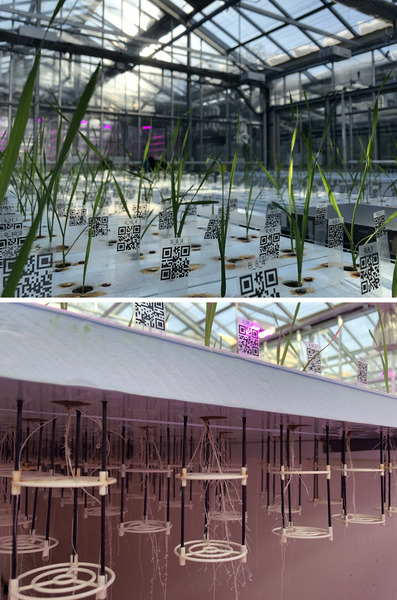
RootPhAir platform in UCLouvain. First SolACE aeroponic experiment with the two wheat panels SolACE. Photo: Clothilde Collet, 2018.

The series includes three parts:

1. Too Deep or Not Too Deep: Deep-rooting – 20 January, 2022

We will look at deep-rooting, including modelling, to consider how a vertical approach contributes to this field, including a virtual look at the Radimax KU facility used in the SolACE project and contributions from Matthias Wissuwa of the Japan International Research Center for Agricultural Sciences.

Lead organiser: Kristian Thorup-Kristensen, University of Copenhagen

2. To Dig or Not To Dig: Root phenotyping for breeding – 10 February, 2022

This event will cover root phenotyping strategies and tools that are within the reach of breeding, with a particular attention to the value and limitations of field and controlled conditions phenotyping. It will include contributions from the SolACE project and benefit from the long experience and vision of Jonathan Lynch (Penn State University).

Lead organiser: Xavier Draye, Université catholique de Louvain (UCL)

3. To Interact or Not to Interact: The Root Microbiome – 3 March, 2022

This event will decipher the expectation for a better understanding of plant and microbiome interactions, including tools and methods for root phenotyping and characterization of structural or functional traits associated with plant-microbiome-soil interactions. Laurent Philippot of INRAE will provide an opening presentation, followed by examples from SolACE project trials of bio-stimulants and a virtual tour of a platform (4PMI) devoted to this topic.

Lead organiser: Christophe Salon, French National Research Institute for Agriculture, Food and the Environment (INRAE)


Two additional stakeholder events are also being organised, looking at different outcomes from the SolACE project. These will all feed into the final SolACE stakeholder event, which is being held in Brussels, Belgium on 12 April, 2022.

Further information

For more information about the roots series, please visit: The Roots of Agriculture: A series on below-ground research from the SolACE project

Do you want to add the website to the Home screen?
tap and then scroll down to the Add to Home Screen command.