 This website was archived on August 28, 2025 and will no longer be updated.
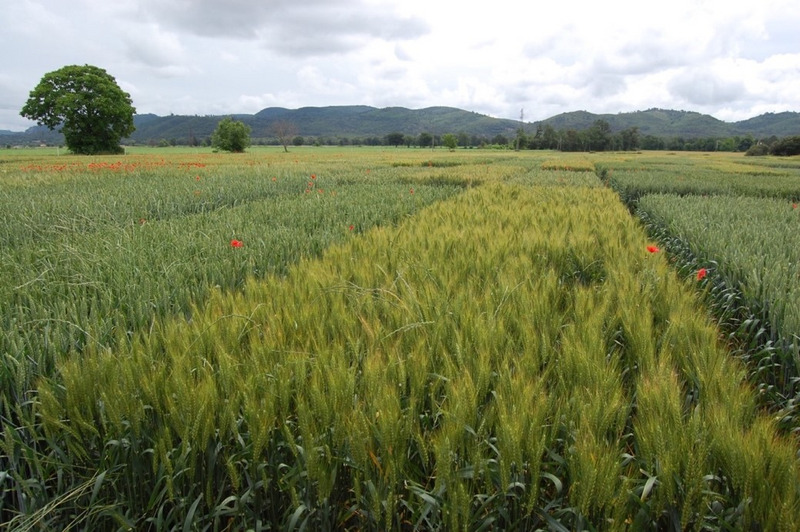
One of the goals of the SolACE project is to better understand crop and microbiome responses to combined water and nutrient limitations. The genotype selection therefore aimed to ensure a high amplitude of genotype responses in the phenotyping platform and field trials. In order to achieve this, data were collected from various sources:
- Four SolACE field trials located in France and Italy,
- Experiments carried out under controlled conditions by SolACE project partners (e.g., an experiment carried out by the Université catholique de Louvain (UCL) about the root angle of young seedlings).
- Data coming from prior field and platform trials (e.g., ArchiRac project, ARVALIS data).
The data were organized into huge data files, with about 250 lines coming from the bread wheat diversity panel and about 250 genotypes from the durum wheat diversity panel. It was decided to separate the analyses between bread and durum wheat to enable more focused discussions and analyses.
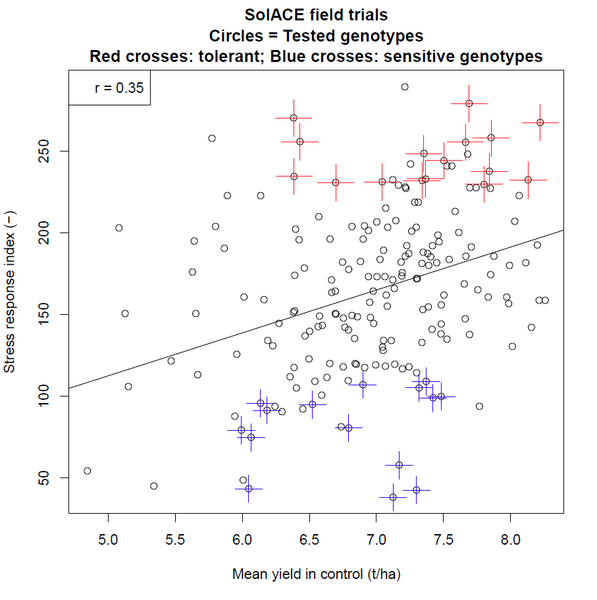
The 40 genotypes of bread wheat were selected based on the ‘LEPSE method’: each genotype was assigned a score according to its response to different environments. The sum of these scores was used to compare the genotypes as it can be considered as a good indicator of stress response across the different environments. The highest values were selected as “tolerant” and the lowest as “sensitive” (see Figure 1). Within those genotypes, care was taken to also keep genotypes with contrasting root traits as well as hybrids and their parents. This method was selected because it kept the largest diversity of response among the 40 selected genotypes.
To ensure a wide variety of responses in the selection of durum wheat, each of the three section from the whole panel was analyzed individually. For each section, the genotypes with the highest and lowest score (as explained above in bread wheat) were selected to form a group of 40 contrasting genotypes coming from the different sections.
We will now conduct more detailed platform and field trials to deeper understand how the selected genotypes react to a combined stress in water and nitrogen and carry out further (eco-)physiological characterization.
Further information
Contact
Clothilde Collet, Université Catholique de Louvain
 tap and then scroll down to the Add to Home Screen command.