Ce site web ne supporte plus Internet Explorer 11. Veuillez utiliser un navigateur plus récent tel que Firefox, Chrome pour un meilleur affichage et une meilleure utilisation.

This website was archived on August 28, 2025 and will no longer be updated.
This page was automatically translated by DeepL

Essais sur le terrain et plateformes de phénotypage

L'analyse génétique (cartographie des QTL) et l'analyse écophysiologique ont été réalisées sur la base d'importantes bases de données collectées à partir d'essais en champ et sur plateforme. Les expériences en plein champ visaient à déterminer la réponse du rendement des panels SolACE aux variations de la disponibilité des ressources. Les plateformes de phénotypage et les expériences en conditions contrôlées visaient à collecter des données sur l'architecture racinaire et la réponse du microbiome aux imitations de ressources combinées.

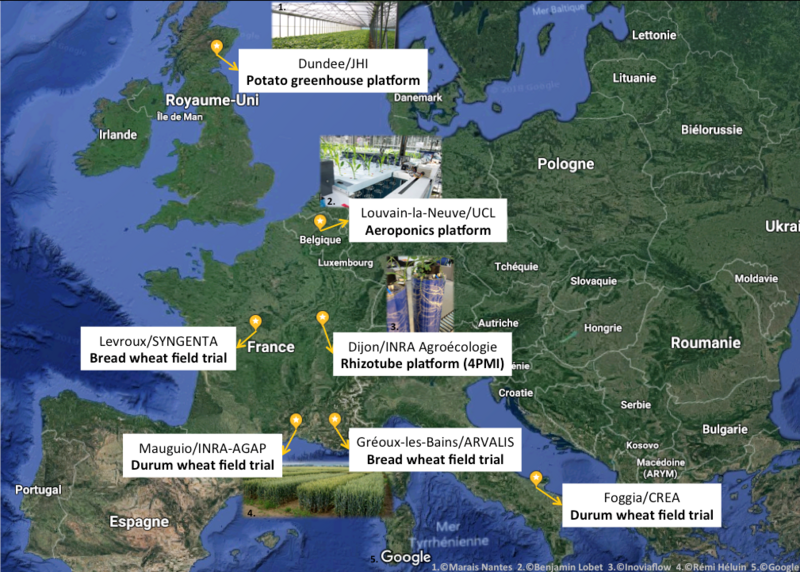
Un large éventail de génotypes de blé a été testé dans quatre essais en plein champ dans des conditions de contrôle et de stress combiné. 250 génotypes de blé panifiable ont été testés dans des essais en plein champ à Levroux, France et Gréoux-les-Bains, France. Par ailleurs, 250 génotypes de blé dur ont été testés dans des essais en plein champ à Foggia, en Italie, et à Mauguio, en France. En outre, les panels de grande diversité ont été phénotypés au niveau des racines dans des essais sur plateforme de phénotypage à Louvain, Belgique et Dijon, France.

Dans un deuxième temps, 80 génotypes sélectionnés (40 de blé panifiable et 40 de blé dur) ont été retenus pour être analysés plus en détail dans des essais semi-contrôlés en plein champ à Gréoux-les-Bains et Clermont, France et Copenhague, Danemark ainsi que dans une plateforme de phénotypage à Montpellier, France.

En plus des essais de blé dur et de blé panifiable, 24 variétés de pommes de terre ont également été testées dans une serre de pommes de terre à Dundee, en Écosse.

Les informations génétiques provenant de ces essais ciblés et à grande échelle ont été combinées dans un cadre de modélisation qui associe des modèles fonctionnels structuraux de plantes (FSPM) et des modèles de cultures afin d'améliorer notre compréhension des performances des cultures sous limitations.

Nouvelles sur les essais de phénotype

Understanding crop and microbiome responses to combined water and nutrient limitations

Part of the SolACE project analyses crop and microbiome responses to combined water and nutrient limitations. Genetic information from large-scale field and platform trials and physiological information from targeted trials are combined in a modelling framework, which couples Functional Structural Plant Models (FSPM) and crop models in order to improve our understanding of crop performance under limitations.

Map of ongoing SolACE field and platform experiments.

Diversity panels (approximately 250 genotypes) of bread and durum wheat and a collection of 24 potato varieties have been defined and assembled. The selection was made by the French National Institute of Agronomic Research (INRA), the National Research Council (CREA) in Italy, ARVALIS, the UK-Based James Hutton Institute and SOLYNTA and was based on a priori genetic and phenotypic information.

Two field trials were installed for each of the wheat panels during autumn 2017. Bread wheat trials were sown in Levroux (SYNGENTA, France) and Gréoux-les-Bains (ARVALIS, France), and durum wheat trials were sown in Foggia (CREA, Italy) and Mauguio (INRA, France). At all places, each genotype will be exposed to combined water and nitrogen limitations and compared to a control scenario. Field partners are currently working with modellers to establish the final list of variables that will be measured.

The 24 potato varieties have gone through a first greenhouse assay to confirm the interest of the collection. The next trials are in preparation. They will focus on root system architecture, yield and canopy development, and will come up with a novel diagnostic transcriptome test.

We will soon begin the high-throughput root phenotypic platform trials that will be performed at Université catholique de Louvain (Belgium) and at INRA-Dijon (France).
By the end of the summer, the field and platform data from wheat experiments will be analysed together and discussed broadly with partners to determine a short collection of 40 genotypes that will be analysed in more detail within intensified field and platform trials.

More information about work package 2.

Souhaitez-vous ajouter le site web à l'écran d'accueil ?